
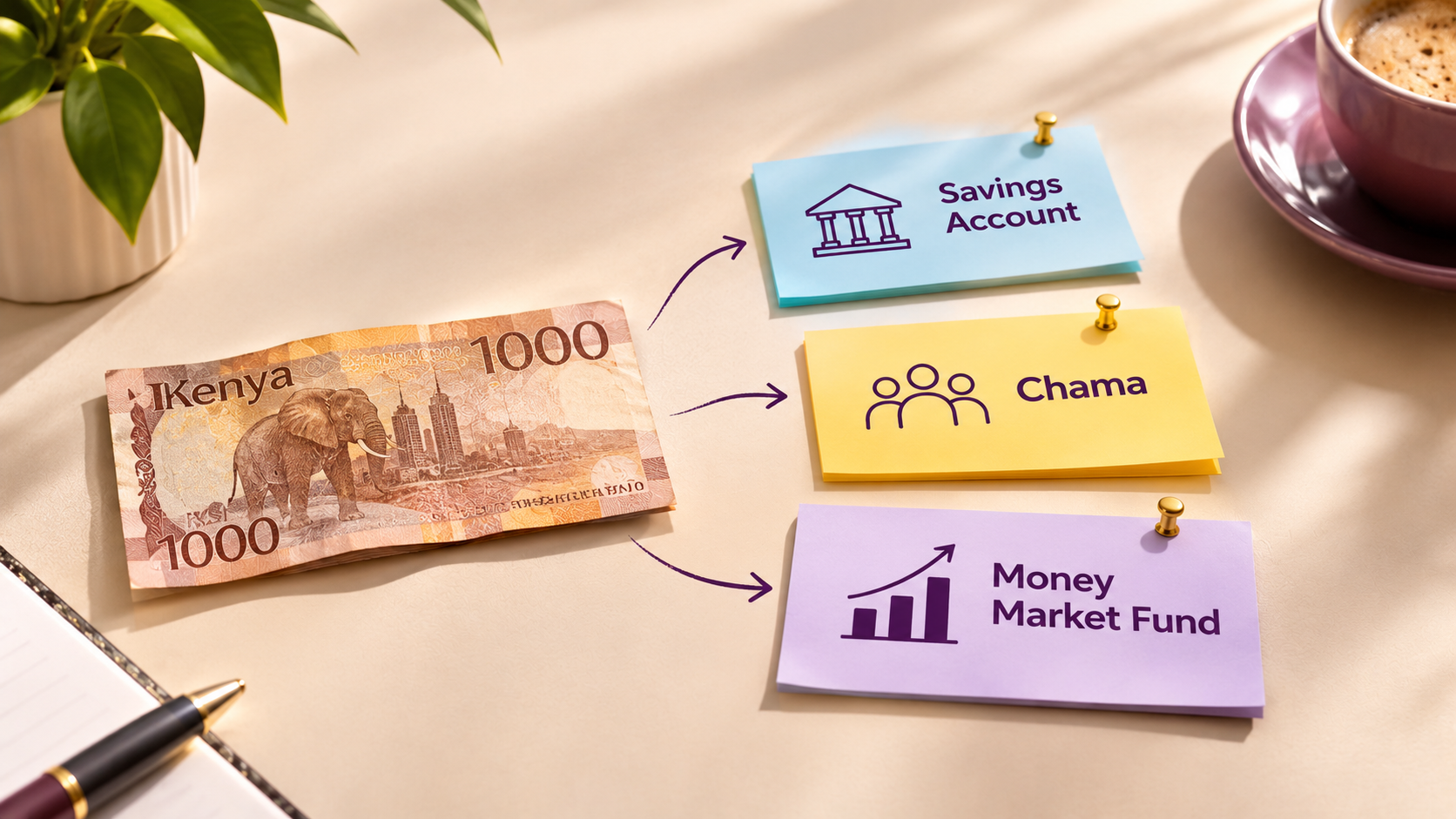
These days, a Ksh 1,000 note rarely survives the week. It turns into airtime, a quick lunch, a top-up for someone back in the village, and by Friday nobody can say where it went. A money market fund could change that story.
But look at that Ksh 1,000 differently. Putting it somewhere it can grow is one of the easiest and most prudent money habits to start, and in Kenya there are three places most people consider first: a savings account, a chama, or a money market fund.
A savings account is the familiar choice. Your money is safe, you can reach it whenever you like, and it sits right next to your everyday banking. The catch is that easy access works both ways. When the money is one tap away from your spending, it has a way of leaving quietly, and the interest on many ordinary savings accounts is modest.
A chama brings something no app can: people. Members hold each other accountable, and the discipline of a fixed monthly contribution is hard to beat. Many women build their first real savings this way. The trade-off is that your money follows the group’s rules, so getting it out early is not always simple, and returns depend on how well the group invests.
Why a money market fund is the middle ground
A money market fund sits between the two. You put in money, a professional fund manager invests it in low-risk options such as government securities and bank deposits, and interest is calculated daily. You can withdraw when you need to, but the money is far enough from your M-PESA to stop or reduce impulse spending.
The Jubilee Money Market Fund (KES) is a good example of how accessible this has become. You open an account online through JAMHub, and Jubilee says you can start with as little as Ksh 100.
As at 24 November 2026, Jubilee put the fund’s effective annual yield at 10.04%. At that rate, Ksh 20,000 left untouched for a year would earn roughly Ksh 2,000 before tax. Returns usually change with market conditions and are not guaranteed, but for money you want working rather than sleeping, this is a strong option.
To open an account, you need to be 18 or older, a Kenyan citizen or legal resident, with a valid national ID or alien ID. Once your money market fund account is running, you can top up whenever you have spare cash, so the habit grows a little at a time.
There is also an extra reason to start now. Jubilee’s “It’s On with Jubilee MMF” campaign runs until 18 December 2026 for new customers, and here is how to go about it and be a winner:
- Open a Jubilee Money Market Fund (KES) account and invest at least Ksh 1,000, and you could be the tenth qualifying customer of the week and win Ksh 5,000.
- Share a post about saving for your child’s education, tag Jubilee and use #ItsOnWithJubileeMMF, and you could win the Ksh 50,000 School Fees Support prize.
- Invest Ksh 20,000 or more and you could be the 100th qualifying customer, who wins the Ksh 100,000 grand prize, announced on 21 December.
So where should your Ksh 1,000 go? Many people keep their chamas for the community and the accountability, and many keep a little in the bank for emergencies. But if you want your money to grow while staying within reach, a money market fund is the simplest first step, and Jubilee is giving new savers a good reason to take it before the year ends. Read more on how the Jubilee Money Market Fund rewards new savers.
Full campaign terms are on Jubilee’s website.
Never miss a story 💜
Breaking news, real stories and money tips for Kenyan women, as they happen.

