
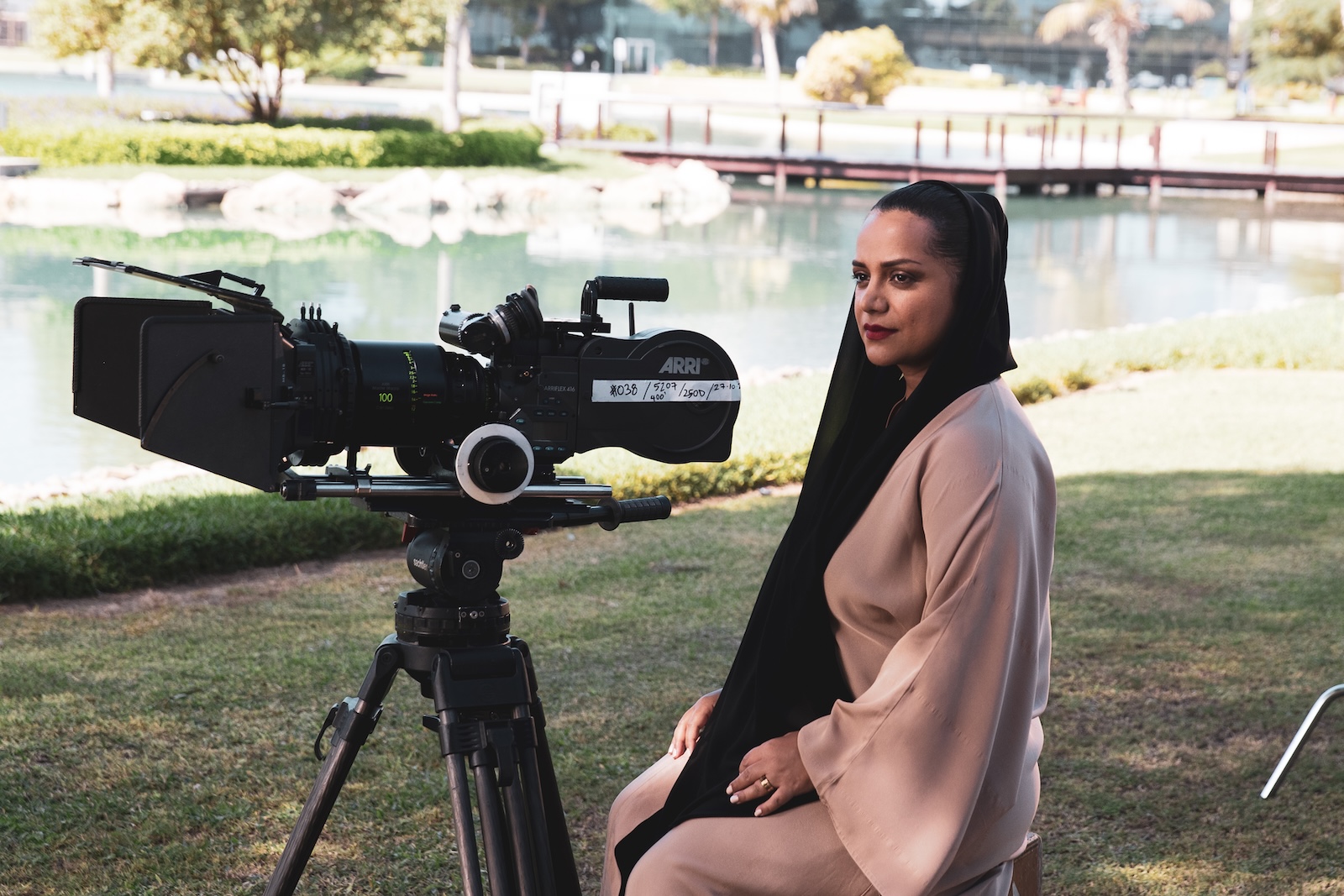
Nayla AlKhaja Directing Style explores grief, identity, silence, and emotional tension through psychological storytelling in contemporary cinema.
For many years, conversations about Middle Eastern cinema largely focused on festivals, imported productions and actors, without much mention of filmmakers. But this is changing as Gulf filmmakers take on the mantle to tell their own stories, with rich cultural references and depth.
One of the names that continue to draw attention is Nayla Al Khaja who is widely known as the first female film director in the United Arab Emirates. Her work has steadily pushed Emirati cinema into international conversations while staying deeply rooted in personal storytelling.
Al Khaja’s films often sit in uncomfortable emotional spaces. Grief, identity, fear, loneliness, and family tension appear repeatedly in her narrarives, with approachs of psychological drama rather than straighforward story telling. That style has become one of the defining features of her successful directing career.
Nayla AlKhaja Directing Style – Projects with clear approach
Al Khaja’s recent projects, including Three and Baab, reflect that approach clearly. Three, which premiered in 2024, follows a family struggling to understand their child’s disturbing behavior while at the same time balancing medical explanations and traditional beliefs. Meanwhile, Baab explores grief and memory through psychological storytelling and surreal imagery. The film also brought together an international creative team, including Oscar-winning composer A. R. Rahman.
Speaking about her path into filmmaking, Al Khaja says she was drawn to storytelling early in life because she wanted to understand people and emotions. She noticed that women from the region were rarely portrayed with emotional complexity on screen and that absence stayed with her and shaped the stories she eventually chose to tell.
“I was drawn to storytelling from a very young age, not just as a form of entertainment, but as a way to understand human behavior,” she says. “Film gave me a language to explore what is often left unspoken.”
That emotional focus shapes how she works with actors. Rather than concentrating only on dialogue or performance during filming, she spends time building psychological histories for each character before production begins. She says actors need to understand why a character behaves a certain way before stepping in front of the camera.
Her visual choices follow the same philosophy. Tight framing, silence, stillness, and negative space frequently appear in her films because she wants the camera to reflect a character’s internal state instead of simply recording events.
“The camera is not just observing,” she explains. “It is participating in their emotional journey.”
Sound also plays a central role in Al Khaja’s films. In Baab, she used sound design as part of the storytelling itself, particularly through the theme of tinnitus. She says silence can sometimes carry more emotional weight than music, depending on the scene.
That attention to emotional atmosphere has helped define her directing signature. Asked to describe her style, Al Khaja calls it “atmospheric and psychological.” She says she prefers creating feelings instead of explaining every detail directly to audiences.
Dubai itself has also shaped her filmmaking. She describes the city as a place built on contrast, where tradition and modernity constantly exist side by side. Those tensions appear repeatedly in her storytelling, particularly in films dealing with identity and isolation.
Instead of focusing on postcard images of Dubai, she says she is drawn to older districts, industrial areas, desert spaces, and private interiors. Those locations, she believes, reveal the emotional reality of the city more honestly than glossy skylines.
Her career has unfolded alongside the rise of the UAE’s film industry. Over the last decade, Dubai and Abu Dhabi have increasingly positioned themselves as production hubs for regional and international projects. Al Khaja believes the growing infrastructure has created room for experimentation because filmmakers are still shaping the industry instead of following rigid systems.
That freedom has allowed her to develop a voice that feels personal rather than formula driven.
She has also become an important figure for women entering film production across the region. Her advice to emerging female directors is direct and practical.
“Don’t wait for permission,” she says. “Be prepared, know your craft, and trust your voice.”
The comment reflects the wider path of her career. Al Khaja entered an industry with few female role models in the Gulf and gradually built space for herself through independent filmmaking, commercial projects, and international collaborations. Today, her films regularly travel through festivals and cinemas beyond the Middle East, placing Emirati storytelling in front of wider audiences.
Her next project remains under wraps for now, though she hints that another film is already in development.
Never miss a story 💜
Breaking news, real stories and money tips for Kenyan women, as they happen.

