
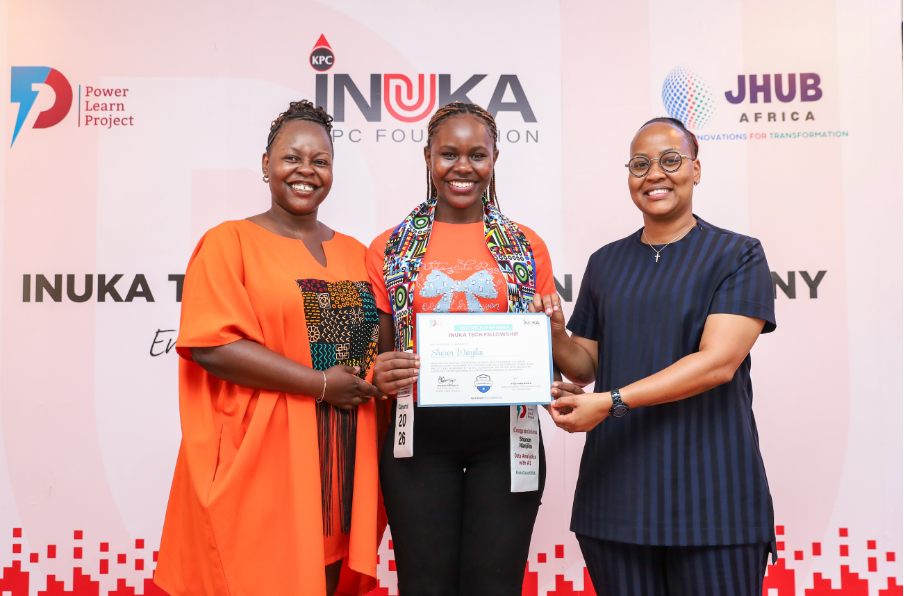
Forty-five young Kenyans who spent the last 6 months learning to code, build dashboards and work with fibre optic technology are now putting those skills to work. 60% of them already have jobs, and 5 are in talks with a bank to turn an app they built into a real product.
The graduates are the first cohort of the Inuka Tech Fellowship, run by Kenya Pipeline Company (KPC) Plc through its philanthropic arm, KPC Foundation. The team of 5 is in discussions with Family Bank to commercialise the digital solution they developed during the programme.
KPC ran the fellowship with Power Learn Project (PLP) and with Jomo Kenyatta University of Agriculture and Technology through JHUB Africa. It combined technical training, mentorship and industry exposure so that participants left with practical skills employers want. More than 1,000 people applied, and 50% of the final cohort were women. They studied Python, machine learning, dashboard development, automation tools, data storytelling and fibre optic technology. They also earned globally recognised certifications and worked on real industry projects.
At the graduation ceremony at KPC headquarters in Nairobi, KPC Foundation Manager Rachel Gathoni said the programme showed what happens when training is linked to real jobs and business opportunities. “We are encouraged by the progress of the 45 graduates, with many already securing employment, progressing to attachments and apprenticeships or pursuing opportunities to commercialise their ideas,” she said. The next step, she added, is to build stronger links with industry and keep supporting the graduates as they build lasting careers.
Mumbi Ndung’u, Executive Director and Founder of Power Learn Project, said the programme prepares young people to compete globally. “Technology is a powerful equaliser, but practical skills are what set young people apart in a competitive global economy,” she said. “Graduation is just the beginning of that journey.”
Dr. Lawrence Nderu of JHUB Africa stressed the value of industry placements. “At JHUB Africa, we are encouraged that all 15 fellows in the fibre optic cohort have secured industry placements. However, placement is only the beginning,” he said. The aim, he added, is to turn that experience into competence, confidence and sustainable careers.
Zilper Abong’o, General Manager, Strategy and Commercial Services, spoke for the KPC Foundation Board of Trustees. Abong’o said the fellowship is part of a long-term investment in people that supports Kenya’s digital transformation and helps close the gap between what training provides and what industry needs. “By bridging the gap between technical training and industry opportunities, we are building a pipeline of skilled talent to support Kenya’s digital economy, drive innovation and create employment,” Abong’o said.
The Foundation now plans to grow the programme along 2 paths. One will help graduates turn their ideas into businesses, and the other will strengthen links with employers. KPC Foundation is talking to prospective partners, including Family Bank Foundation, about scaling up, and the next cohort is expected to be announced in the coming weeks.
For the hundreds of young people who applied and missed out this time, that means another shot at getting in is coming soon.
Never miss a story 💜
Breaking news, real stories and money tips for Kenyan women, as they happen.

