
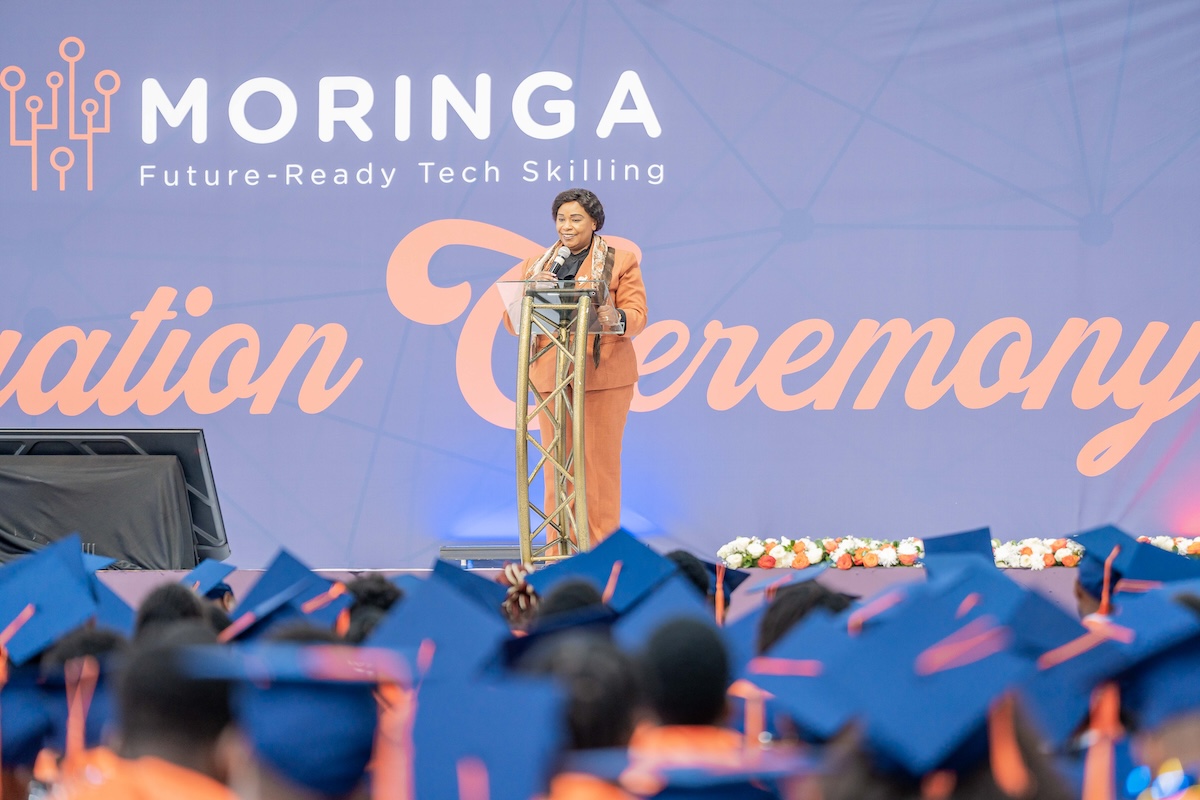
Moringa marked the graduation of 1,761 learners in Nairobi this week, bringing together employers, education leaders and government officials for a joint graduation and career fair held at The Dome, within the Nairobi International Trade Fair grounds on ASK land.
The graduating class completed training across eight technology disciplines: data science, artificial intelligence, cyber security, data analytics, software engineering, DevOps, product design, and data visualization. Taken together, these areas span the core skills needed to build, analyze, improve and secure modern digital systems, from writing and maintaining software to protecting networks and interpreting large datasets.
Mary Kerema, Secretary for ICT, E-Government and the Digital Economy, stood in for Chief Guest Eng. John Kipchumba Tanui, Principal Secretary for the State Department for ICT and the Digital Economy. In her remarks, she framed Kenya’s technology ambitions in terms of building capacity rather than simply consuming it, arguing that the country intends to become a producer and exporter of digital solutions rather than a passive user of them. She linked that goal to training models, like Moringa’s, that combine hands-on project work with strong industry connections, saying this kind of practical education is what needs to scale nationally so graduates can address homegrown challenges.
Moringa’s Chief Executive Officer, Nikki Germany, spoke about the shift in what employers now expect from technology hires. Rather than narrow tool proficiency, she said, companies are looking for people who can diagnose problems, exercise sound judgment, collaborate effectively and keep learning as the field evolves. She described the graduation as a recognition of the cohort’s discipline, while the accompanying career fair was meant to translate that technical ability into real job prospects and longer-term career paths.
The event coincided with Kenya’s rollout of its Artificial Intelligence Strategy for 2025 to 2030, a period in which many local employers are also working out their own readiness for AI adoption. According to organizers, the emphasis going forward is shifting away from simply widening access to digital skills training and toward producing graduates who can apply those skills responsibly, communicate well, solve real problems and adapt as tools and job requirements shift.
Two student projects were highlighted publicly during the event. Data Science graduates built Nairobi Floodguard, a project examining flood risk in the city alongside ways to optimize matatu routes through flood-prone areas. Software engineering graduates presented TerraFold Trace, which looked at how technology might improve traceability within agricultural supply chains.
Beyond the ceremony itself, the career fair portion connected graduates and alumni directly with employers, recruiters and mentors through networking sessions, practical challenges and career guidance activities. Organizers noted that the fair also illustrated how artificial intelligence, data, software development, cloud computing and cybersecurity are increasingly intertwined in practice, which raises the stakes around security, ethics, privacy and system resilience.
Individual graduates carried their own stories into the day. Valedictorian Thomas Amuti, a data science graduate, reflected on the varied backgrounds and obstacles within the cohort, noting that learners came away having practiced working through uncertainty and building alongside others. He added that finishing the program was not an endpoint but a reminder that graduates still need to keep sharpening their skills and show what they can contribute going forward.
The cohort’s graduates included both people starting new technology careers and working professionals upskilling to stay current in a fast-changing industry, a mix organizers described as reflecting the dual paths into Kenya’s growing digital economy.
Never miss a story 💜
Breaking news, real stories and money tips for Kenyan women, as they happen.

