
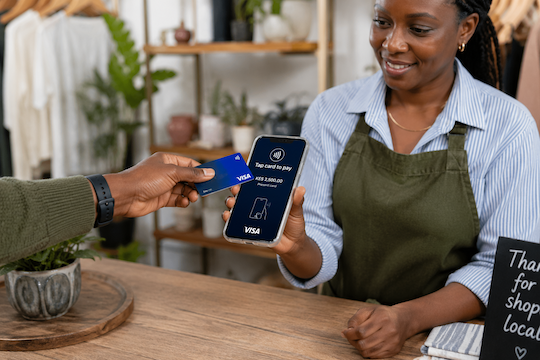
In Kenya, the smartphone has taken on almost every job a small business needs done. It is where where marketing for businesses happens, where the books get kept, and where customers reach the owner directly. Now it’s starting to take over one more role. The card machine’s.
Visa is powering that shift through Tap to Phone, a service running on the Visa Acceptance Platform and now available via KCB Bank Kenya. The idea is simple. Instead of a business buying a separate card reader, the merchant holds up their Android smartphone, and the customer taps their bank card against it to pay. No terminal, no extra device, no upfront investment beyond the phone already sitting in their pocket.
For a country where mobile money already runs much of daily commerce, this feels natural and like the next logical step.
Point-of-sale terminals have always been a chicken and egg problem for small businesses. You need one to accept cards, but the cost of getting one often outweighs the volume of card transactions a small shop expects to see. That calculation worked fine for supermarkets and big retail chains, but rarely for the market trader, the mobile hairdresser, or the temporary vendor at a weekend exhibition.
Tap to Phone strips that cost out of the equation entirely, and it does so without cutting corners on security, with a safeguard called tokenisation. In plain terms, when a customer taps their card, the actual card number never travels through the transaction at all. Instead, the system swaps it out for a one-time ‘token’ that only means something within that specific payment and is useless to anyone who might intercept it.
That’s what allows a card to be tapped against an ordinary smartphone rather than a purpose built terminal, without leaving customer data any more exposed than it would be on a standard card machine.
For the merchant, none of that machinery needs to be understood or managed. What matters to them is simply that the phone is already in their hand now doubles as a secure checkout counter.
Kenyan entrepreneurs already run their businesses through their phones. Orders come in on WhatsApp. Customers find them through Instagram or TikTok. Deliveries get sorted out in a phone call, and sometimes the day’s sales get logged in a mobile app before bed. Tap to Phone just adds one more function to a device that was already doing most of the heavy lifting.
The scenarios for the magic of Tap To Pay are endless. The freelance photographer shooting a wedding, the fitness coach training clients at a park, the vendor at a weekend market who packs up and moves locations every few days. For them, a bulky POS terminal was never really practical anyway, and a phone they’re already carrying is.
It’s also a meaningful shift for women-led businesses and growing enterprises that often operate on tighter margins and cannot absorb the cost of new equipment. Removing that barrier doesn’t just make card payments possible. It makes them worth offering in the first place.
Tap to Phone sits alongside other tools in Visa’s push to widen digital payment access in Kenya, including Visa Accept and the broader Visa Acceptance Platform, developed through partnerships with local banks and technology providers. The common thread across all of them is the same, to reduce the infrastructure that a business needs before it can accept a card.
For thousands of small business owners across the country, that could mean that the next customer who wants to pay by card no longer has to be turned away. The equipment for that sale is already in their pocket.
Never miss a story 💜
Breaking news, real stories and money tips for Kenyan women, as they happen.

