
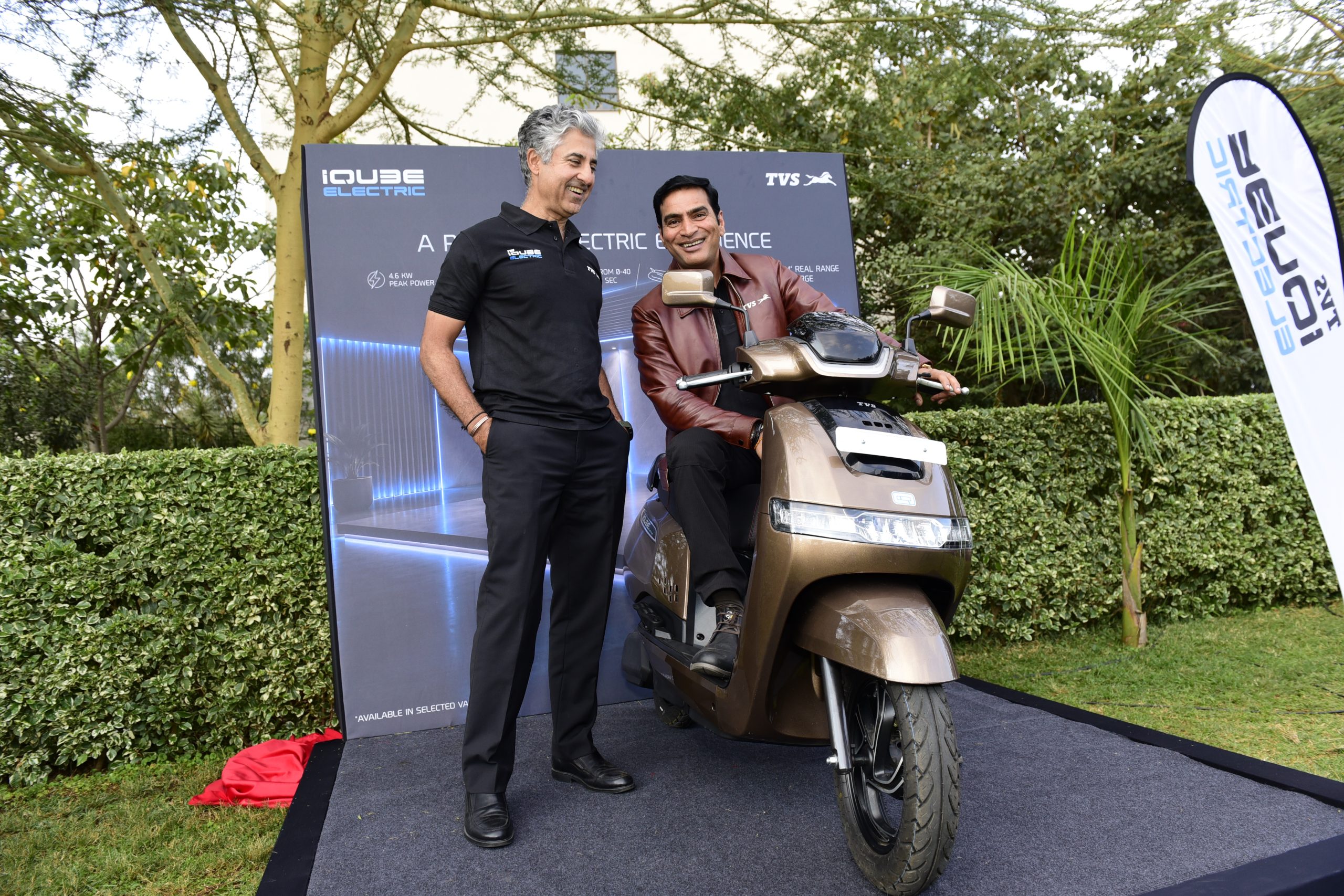
Every matatu fare hike, every boda boda rider raising his rate because fuel went up again, it all traces back to the same thing. The cost of keeping anything with an engine moving through Nairobi’s traffic. TVS Motor Company is betting that Kenyan riders are ready for something different, and it has just launched its premium electric scooter, the TVS iQube, in Kenya, marking the brand’s first entry into the African market. For a company ranked as the fourth largest two-wheeler manufacturer in the world, this is not a small move.
Built for everyday city travel, the iQube is meant to handle the stop-start rhythm of urban commuting, weaving through traffic, running errands, and getting to work, without the running costs that come with a petrol engine. It will be sold through Car & General, a name that has been part of Kenya’s motoring landscape for over two decades, which also means buyers get an established after-sales network rather than a brand-new, untested support system.
Peyman Kargar, President of International Business at TVS Motor Company, said the launch reflects the company’s push to grow its electric offerings across international markets. “Driven by our vision to transform lives through exciting, responsible, and sustainable mobility, we are proud to introduce the TVS iQube in Kenya, marking our entry into the African market,” he said, adding that the company sees this as a meaningful step in its global growth.
Vijay Gidoomal, Chief Executive Officer of Car & General, pointed to the numbers behind the timing. He noted that Africa’s two-wheeler market is growing at roughly 7 to 10% a year through 2030, but the electric segment is expanding much faster, with projections of 15% to 25% growth through 2030 and 2031. As he put it, electric bikes are still a small slice of the market for now, but the conditions are right for that to change quickly.
Madhu Prakash Singh, Vice President of International Business at TVS Motor Company, said the scooter is designed to meet urban commuters where they are, prioritizing comfort, connectivity and everyday practicality. He noted that the iQube already has over one million happy customers worldwide and offers running costs that are a fraction of what a petrol scooter demands.
On the practical side, depending on the model, the iQube can travel between 75 and 115 km on a single charge, and charging is as simple as plugging into a normal wall socket at home using the portable charger; no need to hunt down a special charging station. It also connects to a smartphone through the SmartXonnect platform, giving riders navigation, ride details and charging information at a glance, alongside everyday conveniences like generous underseat storage and reverse parking assist.
The savings extend beyond the pump too. Compared to a typical 125cc petrol scooter, riders could save around Kshs 47,000 a year in energy and maintenance costs alone, a number that adds up fast for anyone commuting daily.
Globally, the numbers behind the iQube are hard to ignore. Riders have collectively covered more than 17.8 billion km on the scooter, helping avoid 623,595 tonnes of CO2 emissions, roughly the same impact as planting 25 million trees.
In Kenya, the iQube will come in two variants, the iQube 3.5 with a real-world range of 115 km and the iQube 2.2 with a range of 75 km, both backed by a two-year or 30,000 km warranty, whichever comes first, along with nationwide after-sales support through Car & General.
Whether this is the moment Kenyan riders start making the switch remains to be seen, but TVS is clearly banking on it, and it is doing so with the backing of a dealer network that already knows the local roads.
Never miss a story 💜
Breaking news, real stories and money tips for Kenyan women, as they happen.

