
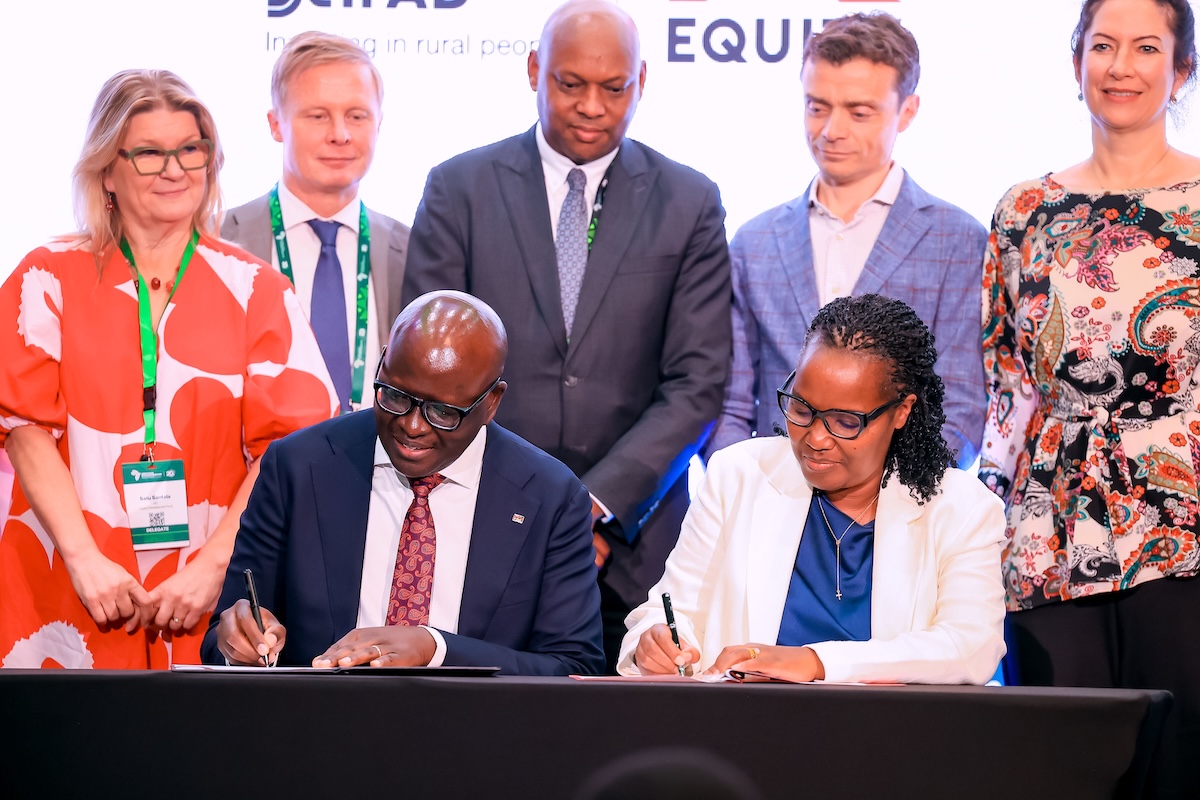
Access to climate adaptation finance remains out of reach for most smallholder farmers and rural businesses across Africa, with available capital rarely reaching those who need it most. To help close that gap, the International Fund for Agricultural Development (IFAD) and Equity Group have launched the Africa Rural Climate Adaptation Finance Mechanism (ARCAFIM), a 200 million dollar, private sector led mechanism, at the Africa Food Systems Forum 2026 in Kigali, Rwanda.
The mechanism is convened with co-financiers the Green Climate Fund, Finland’s Ministry for Foreign Affairs and the Nordic Development Fund, with additional co-financing from the Government of Denmark and the European Union.
ARCAFIM runs for twelve years and is structured in two parts, 180 million dollars in lending capital and roughly 20 million dollars in technical assistance. Since the lending capital revolves over about four investment cycles, it is expected to generate around 266 million dollars in loans to micro, small and medium sized enterprises and smallholder farmers across East Africa’s food systems.
What sets ARCAFIM apart is a detailed climate adaptation taxonomy meant to transfer practical knowledge on viable adaptation investments to participating banks, farmers and agro-businesses, paired with a structure where a commercial bank carries risk alongside public capital rather than simply administering it. Of the 180 million dollar lending base, 90 million comes from Equity Group’s own balance sheet, matching the concessional contribution dollar for dollar. Credit protection is layered across the portfolio, with international partners absorbing first losses, a mezzanine layer shared with the bank, and Equity carrying the senior risk.
The programme covers Kenya, Uganda, Tanzania and Rwanda, aiming to reach roughly 260,000 smallholder producers and 500 rural MSMEs, with at least half of beneficiaries women and 30 percent youth. It is expected to strengthen food security for about 1.2 million people and benefit an estimated 1.5 million people overall.
Dr. Gérardine Mukeshimana, IFAD Vice President, said the goal is to make rural climate adaptation “a recognizable, viable and sustainable business line for African financial institutions,” adding that the mechanism starts in East Africa but is built for wider replication.
The technical assistance strand functions as core financial architecture rather than an add on, building capacity among microfinance institutions and SACCOs to originate adaptation lending, while helping farmers identify investments such as irrigation, livestock resilience, storage and renewable energy.
Dr. James Mwangi, Group CEO of Equity Group Holdings, said African smallholders are entrepreneurs who have simply lacked a financial system built to back them, and framed ARCAFIM as an effort to build a lasting market rather than fund a single project.
Moses Nyabanda, Managing Director of Equity Bank Kenya, said the bank will finance farmers directly and through MFIs, SACCOs and value chain companies, while building capacity around climate adaptation and sustainable agricultural practices.
Catherine Koffman of the Green Climate Fund described the initiative as an example of GCF’s catalytic role in structuring mechanisms that mobilise commercial capital for climate resilient agriculture. Finland’s Juha Savolainen called mobilising private capital central to the country’s development policy, while Nordic Development Fund’s Satu Santala said NDF was proud to help reduce investment risk and mobilise financing for smallholder farmers from the mechanism’s earliest stages.
The launch brought together IFAD and financing institution representatives, government officials from the four participating countries, private investors and development partners. Agreements were signed by Mukeshimana for IFAD and Nyabanda for Equity Bank Kenya, in a ceremony led by Hannington Namara, Managing Director of Equity Bank Rwanda.
IFAD and Equity Group have already identified Southern and West Africa as the next regions for replicating the model.
Never miss a story 💜
Breaking news, real stories and money tips for Kenyan women, as they happen.

