
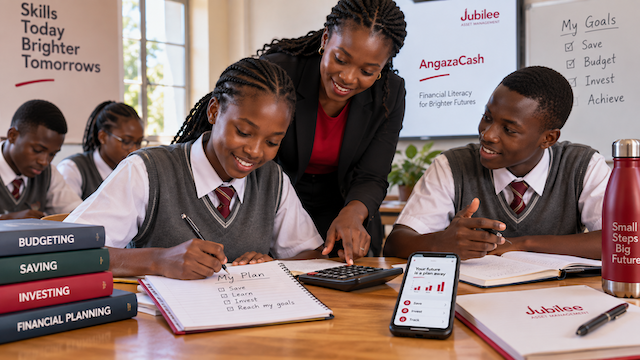
When money lessons start early, Jubilee AngazaCash Financial Literacy programme takes them further.
By the time a young Kenyan receives their first salary, they may already have spent years making financial decisions.
In my case, for instance, money management started in the days of piggy banks, when our parents taught us how to save for candy and snacks. Then I went to boarding school at an early age and learned how to stretch pocket money till the next visiting day, and even save a little for use during school holidays.
Through sporadic starts and stops, I learned how to save for goals, abandon them, start over, often fail altogether and sometimes succeed. Clearly I had the foundation in financial literacy, and so do many other young people. What is often missing is a structured understanding of what those decisions mean.
That is the gap Jubilee Asset Management is trying to address through the AngazaCash, its financial literacy programme for high school students.
Money habits do not suddenly appear when someone gets a job. They develop through small decisions made much earlier in life, including how a young person thinks about spending, saving and planning for something they want.
Kenya’s financial inclusion strategy recognizes financial literacy as an important part of financial well-being. The National Financial Inclusion Strategy 2025-2028 places financial literacy among its key priorities while also identifying young people as a group requiring greater access to financial services, savings and investment products. Source.
That creates a practical question for families and schools. Where do young people learn how money works? One response to this is the Jubilee Asset Management’s AngazaCash financial literacy initiative was launched during Global Money Week in March 2026. The programme has sessions covering areas such as budgeting, financial planning, responsible money management, saving and investing. It is delivered in partnership with Igniting Gems Mentorship, a youth-focused organization with experience in outreach, training, research and community engagement. Source.
We can all agree that good saving habits is often where conversations about financial literacy begin, but AngazaCash takes a wider view of this.
Students are encouraged to think about personal goals and the decisions required to reach them. That includes understanding how a budget works, why discipline matters in saving, and how investing can contribute to longer-term financial security.
It is important for young people to make these distinctions. Knowing that saving is important is different from knowing how to make a saving decision. A young person may understand that they should put money aside but still need help working out how much, for what purpose and how to go about unexpected expense.
Such are the pillars on which financial confidence is built, and this creates the ability to look at the money available and make an informed choice, rather than simply spending whatever money is available.
Since its launch, the AngazaCash financial literacy programme has reached 5,067 students in ten high schools across Nairobi and Kiambu.
Read also – Jubilee Asset Management Celebrates Major Industry Recognition
For parents who want to carry these lessons home, the Jubilee Money Market Fund is often regarded as one of the best short term investment options in Kenya, combining low risk with flexible withdrawals that suits short term goals.
Parents exploring to save for their children’s school fees with a low risk investment option in Kenya, or simply looking to understand how to earn returns on savings in Kenya, can open a Jubilee Money Market Fund account online for themselves and just as easily open one for their children.
Among money market fund options in Kenya, Jubilee’s stands out for how affordable and flexible it is, because one can start investing with as low as KES 100 and grow their investment through top ups via M-Pesa Paybill or bank transfer. What AngazaCash financial literacy program teaches in the classroom, a Jubilee Money Market Fund account can help put into practice at home, giving parents and children a shared, hands-on way to see saving and investing at work rather than just talking about it.
For Jubilee Asset Management, putting financial education into the school years creates an opportunity to introduce these ideas before young people get to make bigger financial commitments. It also changes what financial literacy can mean.
Financial literacy is not just knowing the difference between saving and investing. It is learning to plan before spending, understanding the consequences of financial choices and thinking beyond the money available today.
Those are lessons that can follow a young person well beyond the classroom.
Never miss a story 💜
Breaking news, real stories and money tips for Kenyan women, as they happen.

