
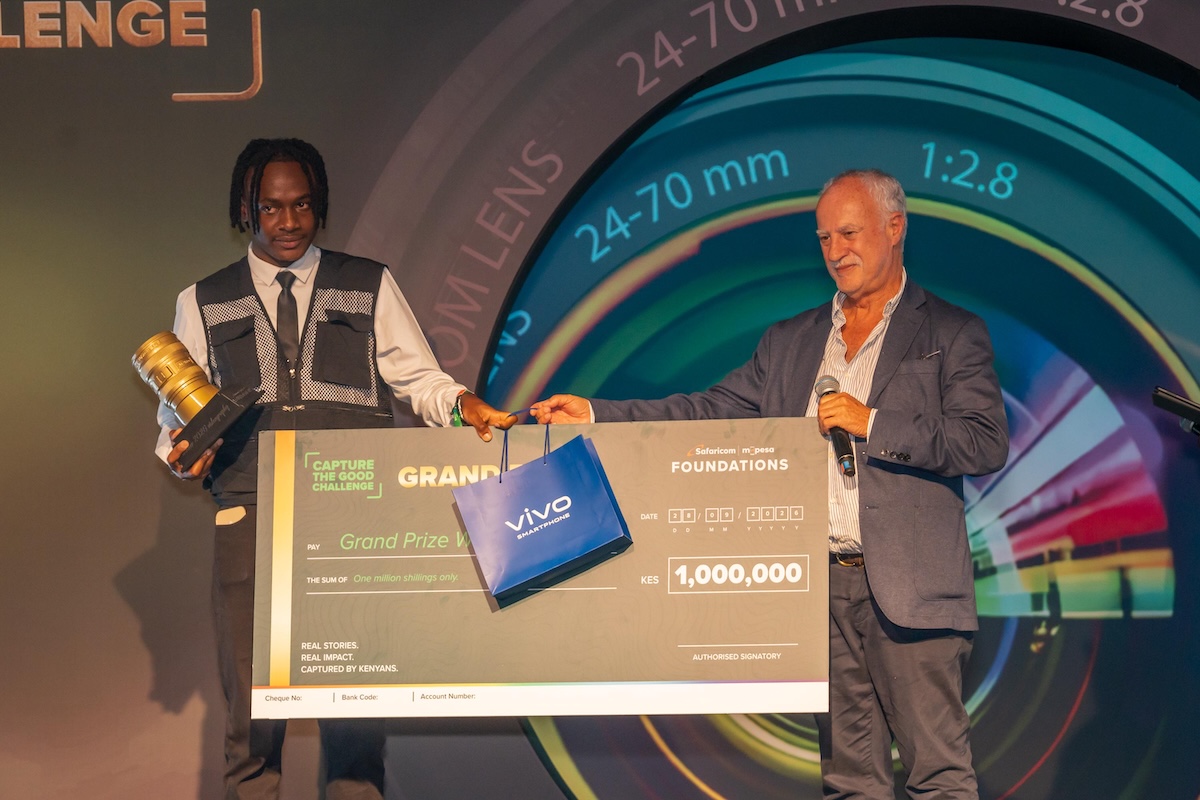
Some of Kenya’s most compelling stories of change are found in ordinary places, from schools and health centres to community projects creating opportunities for young people. Capturing those moments has now earned six Kenyan photographers and videographers national recognition, along with KES 4.5 million in prize money.
The six emerged as the inaugural national winners of the Safaricom and M-Pesa Foundations Capture the Good Challenge, a five-month competition that invited Kenyans to document stories of transformation through photography and video.
The challenge attracted 6,014 applications from across the country, with participants telling stories under three themes: education, health and economic empowerment.
In the photography category, Mathew Meli from Uasin Gishu took the overall prize for his work documenting improvements in school infrastructure. Charles Muia from Embu was named first runner-up for his story on the provision of laboratory equipment, while Lameck Ododo from Kericho placed second runner-up for his work on kitting Kapkatet Football Club.
The videography category produced an equally diverse set of stories. Kennedy Kamau from West Pokot won the top prize for The Dream of Poriot, which looks at the role of proper school infrastructure in education.
David Mutuku from Kajiado was named first runner-up for A Clinic in Kajiado is Helping Bring New Life, a story about access to medical care, while Nairobi-based Phillip Otieno took second runner-up for What These Hands Built, which documents a ball-making project in the capital.
The two overall winners received KES 1 million each. First runners-up received KES 750,000, while the second runners-up took home KES 500,000 apiece.
What started with more than 6,000 applications eventually narrowed down to 90 regional winners, comprising 45 photographers and 45 videographers.
A total of 2,185 participants progressed to the fieldwork stage, with 1,155 entries submitted for judging. From there, 360 entries advanced to the regional stage.
The 90 regional winners were then given an opportunity to sharpen their skills through a two-day masterclass led by established Kenyan photographers and creatives, including Grace Kahaki, Enos Olik, Mbithi Masya and Mutua Matheka.
Following the masterclass, the participants resubmitted their work for the national phase. Eighteen finalists were eventually shortlisted for public voting, which closed on August 30.
The competition also recognised photographers and videographers who made it through the regional stages. Thirty Gold winners received KES 100,000 each, while 30 Silver winners received KES 75,000 and 30 Bronze winners received KES 50,000.
For Safaricom CEO Peter Ndegwa, the competition was an opportunity to give Kenyan creatives a platform to develop their work while allowing communities to tell their own stories.
That idea sits at the centre of Capture the Good. Rather than relying solely on traditional media to document social and economic change, the competition put cameras in the hands of people who were already close to these communities.
The result was a collection of stories spanning different parts of Kenya and covering practical changes in education, healthcare and livelihoods.
The challenge was delivered in partnership with the Photographers Association of Kenya and the Photojournalists Association of Kenya, with vivo as the mobile photography partner.
For the six national winners, the recognition comes with a financial reward. For the wider creative community that participated, the competition also provided an opportunity to have their work seen, receive professional training and compete on a national platform.
And in a country where stories of community change can easily go undocumented, that opportunity matters just as much as the prize money.
Never miss a story 💜
Breaking news, real stories and money tips for Kenyan women, as they happen.

