
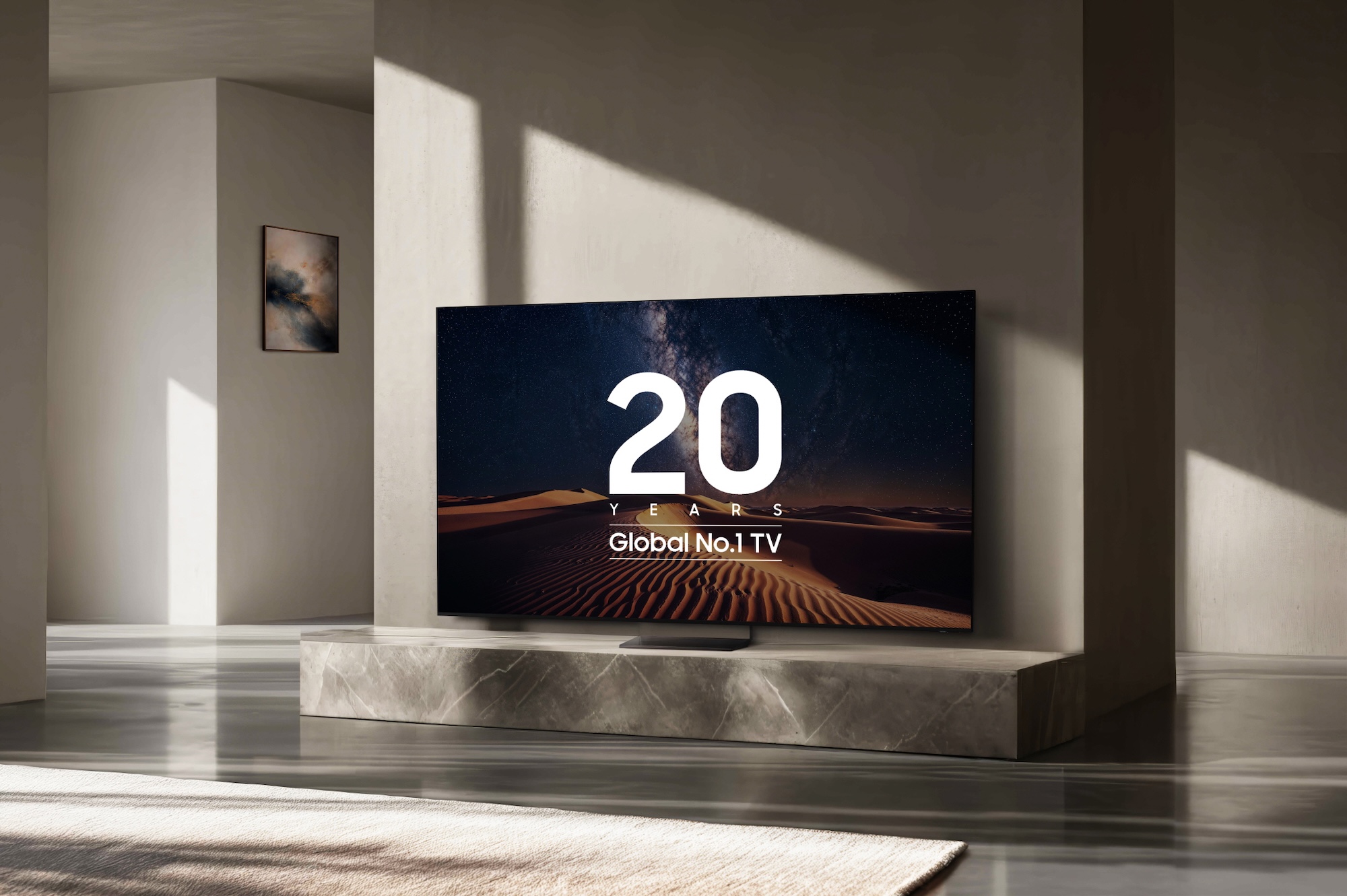
Samsung Global TV Leadership marks twenty years as the company maintains top market share in premium televisions worldwide.
Samsung’s position at the top of the television market has held steady for two decades. The company says it remains the number one TV brand globally, marking 20 consecutive years of leadership in the global TV industry.
Market research firm Omdia reports that Samsung held 29.1 percent of the global TV market in 2025, keeping its lead across several high value segments. The company also dominated the premium category, particularly televisions priced above 2,500 dollars, where it recorded a 54.3 percent market share. In the segment above 1,500 dollars, Samsung controlled 52.2 percent of the market.
For consumers, these figures point to how the television industry has evolved over the last two decades. Samsung’s strategy has focused heavily on premium displays, larger screen sizes, and new display technologies.
Samsung Global TV Leadership – A Two Decade Lead in the Global TV Industry
Samsung first reached the top of the global TV market in 2006, when the company introduced its Bordeaux TV series. The design attracted attention at the time because it moved away from the bulky televisions that dominated living rooms in the early 2000s.
Since then, the company has built its television strategy around new display formats and connected entertainment.
SW Yong, President and Head of the Visual Display Business at Samsung Electronics, said consumer trust has played a central role in the company’s position.
“When consumers choose a TV, they’re choosing a brand they can trust for years to come,” he said. “Our 20-year leadership in the global TV market reflects that trust built on decades of engineering excellence and premium innovation.”
Over the years, Samsung introduced several technologies that helped reshape how televisions function inside homes.
How TV Technology Has Changed
Television technology has moved quickly over the past two decades. Samsung played a visible role in several shifts that changed how screens look and operate.
In 2009, the company accelerated the move toward LED televisions, replacing older display technologies with thinner and more energy efficient panels.
By 2011, Smart TVs arrived. These televisions connected to the internet and allowed viewers to stream shows, watch online video and install apps directly on the screen.
Samsung also pushed design changes that altered how televisions fit into living spaces.
The Serif TV, launched in 2015, treated the television as part of interior design. Two years later, Samsung introduced The Frame, which displays digital artwork when the television is not in use.
The company also continued to focus on picture quality. QLED televisions arrived in 2017, using quantum dot technology to improve brightness and colour accuracy. In 2018, Samsung launched 8K televisions, delivering more than 33 million pixels, four times the resolution of 4K displays.
Another shift arrived in 2020 with Micro LED technology, designed to improve contrast and brightness on ultra large screens.
These developments pushed televisions beyond their original role as simple viewing devices.
Competition in the Premium TV Segment
Samsung’s leadership has been closely linked to the premium television market. Larger screens, advanced display technology and connected features have become key selling points in recent years.
The company continues to expand its lineup with technologies such as Neo QLED, OLED televisions, and newer Micro RGB displays.
Samsung is also increasing its use of Mini LED backlighting, which improves brightness and contrast across different screen sizes. These technologies now appear in several models across the company’s TV range.
Artificial intelligence features also appear in newer televisions. Samsung says these systems adjust picture quality and sound automatically depending on what viewers are watching.
The Next Phase of the TV Market
Television manufacturers now compete heavily in premium display technology, screen size and image quality. Streaming services, gaming and home cinema experiences continue to shape how televisions are designed.
Samsung’s two decade lead in the global TV market reflects the scale of that competition.
The company’s position does not mean the industry stands still. Rival manufacturers continue to push OLED displays, gaming features and AI driven processing.
For viewers at home, the competition usually leads to better screens and more options. Television technology continues to evolve, and manufacturers remain locked in a race to deliver sharper images, larger displays and smarter viewing experiences.
Never miss a story 💜
Breaking news, real stories and money tips for Kenyan women, as they happen.

