
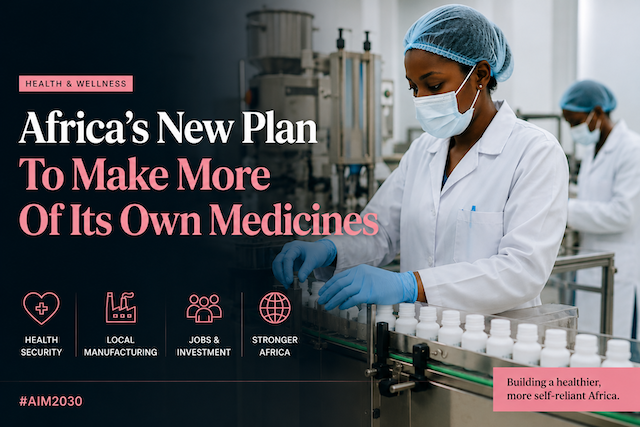
Africa Medical Manufacturing Plan aims to expand pharmaceutical production and reduce Africa’s dependence on imported medicines.
The launch of the AIM2030 initiative in Nairobi this week carried a message that has become impossible for African governments to ignore. Africa cannot keep depending almost entirely on imported medicines, vaccines and medical supplies while facing growing health demands and future pandemic risks.
AIM2030, short for the Africa Initiative for Medical Access and Manufacturing, wants to change that by helping African countries expand local pharmaceutical production over the next five years. The initiative was launched in Kenya with participation from President William Ruto, the World Bank Group, the International Finance Corporation (IFC), the World Health Organization Africa office and senior government health officials from across the region.
The timing matters.
COVID-19 exposed how exposed African health systems had become after decades of relying on imports for vaccines, medicines and other medical products. During the pandemic, many African countries struggled to access vaccines as wealthier nations locked in supply deals and export restrictions slowed distribution.
Today, African countries still import between 70 and 100 percent of finished pharmaceutical products. Around 99 percent of vaccines used across the continent are imported, while less than one percent are produced locally.
Those numbers sit at the center of the AIM2030 push.
Africa Medical Manufacturing Plan – A Push For African Manufacturing
The initiative aims to double pharmaceutical manufacturing capacity in Africa by 2030 through regional production and supply chains. The project focuses on countries including Kenya, Rwanda, Nigeria, South Africa, Ghana, Senegal, Ethiopia, Egypt and Morocco. It is being spearheaded by the World Bank Group and the African Union Commission, alongside Africa CDC and the Africa Medicines Agency.
IFC Managing Director Makhtar Diop framed the issue as one that goes beyond healthcare.
“At its core, AIM2030 is about supporting Africa’s ambition to double pharmaceutical manufacturing capacity by 2030 through stronger regional manufacturing and supply chains,” he said.
Diop also linked the initiative directly to the lessons learned during COVID-19.
“Resilience cannot be imported in the middle of a crisis. It must be built in advance. That is why stronger regional manufacturing and supply chains matter,” he said. “This is about health security. But it is also about jobs, investment, industrial growth, and economic resilience.”
That argument has gained traction across Africa over the last few years as governments try to reduce dependence on external supply chains.
During the pandemic, countries with domestic manufacturing capacity were able to move faster on vaccines, diagnostics and medical supplies. African governments now want local production to play a bigger role in future emergency responses.
Kenya Wants A Bigger Seat In Africa’s Pharma Industry
Kenya’s hosting of the AIM2030 launch also points to Nairobi’s growing ambitions in pharmaceutical manufacturing.
The country already has one of East Africa’s largest pharmaceutical sectors, with dozens of local manufacturers producing medicines for regional markets. Government officials have repeatedly said they want Kenya to become a regional production and export hub under the African Continental Free Trade Area framework.
For Kenya, the conversation goes beyond medicine.
Pharmaceutical manufacturing has become tied to industrialisation, skilled employment and intra-African trade. Governments backing AIM2030 believe local production could reduce supply disruptions, lower long-term procurement costs and keep more investment within African economies.
The initiative also aims to attract private capital into the health sector while improving regional cooperation on regulation and procurement, two areas that have slowed manufacturing growth for years.
The Real Challenge Starts After The Launch
The announcement itself was ambitious. Delivering on it will be harder.
Africa’s pharmaceutical industry still faces major hurdles including financing gaps, fragmented markets, regulatory delays and high production costs. Some countries also struggle with unreliable electricity, limited research capacity and dependence on imported raw materials.
Past attempts to scale local manufacturing have often stalled once political attention faded.
Still, pressure to build regional production capacity continues to grow. Africa has one of the fastest-growing populations globally and demand for medicines, vaccines and diagnostics is expected to rise sharply over the next decade.
For many policymakers, AIM2030 reflects a larger shift in thinking after COVID-19. The continent no longer wants to remain at the back of the queue during global health emergencies.
Never miss a story 💜
Breaking news, real stories and money tips for Kenyan women, as they happen.

