
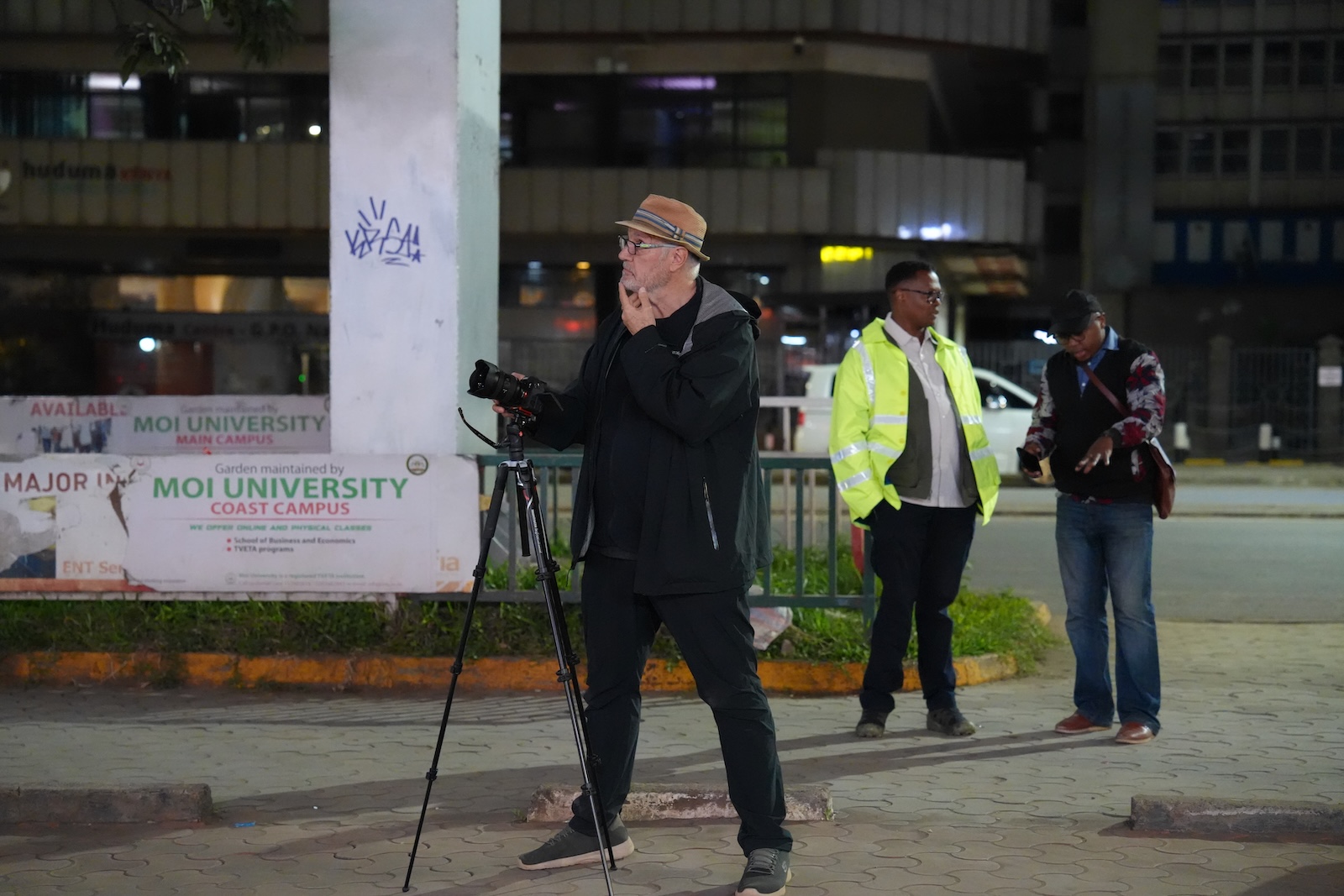
When Italian artist Franz Cerami arrived in Kenya, he was not looking for monuments, landscapes or the familiar postcard images that often define how countries are seen from the outside. He was looking for faces.
Across Kenya’s coffee-growing and processing communities, Cerami met and photographed about 300 women and men whose hands, labour, knowledge and resilience sit behind one of the world’s most cherished beverages. The result is Jute Portraits, a powerful multimedia art project that places Kenya’s coffee workers at the centre of a global cultural conversation.
For Kenya’s creative and cultural sector, this is no ordinary visiting artist project. Cerami is one of Italy’s leading contemporary visual artists working at the intersection of art, technology, public space and human storytelling. Born in Naples, he has built an international practice around digital art, video mapping and public installations that transform buildings, streets and cultural spaces into living canvases. His work has travelled across cities and countries, and he has been appointed three times as Ambassador of Italian Design in the World by the Italian Ministry of Foreign Affairs and International Cooperation.
That such an artist has chosen Kenya’s coffee value chain as his subject is significant. It is a recognition that the stories of farmers, pickers, processors, scientists, exporters and workers are not peripheral to culture; they are culture. They are the people who hold together an economic, agricultural and human story that connects rural Kenya to global markets, and Kenya to Italy.
The project was conceived as part of Italy’s National Day celebrations in Kenya, under the leadership of the Ambassador of Italy to Kenya and Seychelles, H.E. Vincenzo Del Monaco. For the Ambassador, Jute Portraits is more than an exhibition. It is an act of cultural diplomacy, rooted in the shared love of coffee and the deeper relationship between the two countries.
“Italy’s National Day in Kenya is not only a diplomatic celebration,” Ambassador Del Monaco says. “It is an opportunity to speak about the depth of the relationship between our two countries. A relationship built on culture, trade, development cooperation, creativity and people-to-people connections.”
That relationship finds a natural symbol in coffee. Italy is globally associated with coffee culture, from the espresso bar to the rituals of daily conversation. Kenya, meanwhile, produces some of the finest coffee in the world. But Jute Portraits goes beyond the cup. It asks a more important question, who are the people behind the coffee?
Cerami’s answer is visual, intimate and deeply human. He began by photographing workers across the coffee value chain. Later, back in Italy, he reworked the images through painting, watercolour, graphite and digital techniques, transforming the portraits into moving images and large-scale projections. The title itself, Jute Portraits, refers to the jute sacks used to carry coffee, but also to the journey of the people and landscapes that give coffee its meaning.
“The first thing I can say is Angalia hapa, look here,” Cerami recalls, referring to the words he used while photographing people during his journey across Kenya. “Behind every cup of coffee are many hands and many stories.”
In one of the most moving moments of the project, Cerami photographed a 95-year-old woman whose face, strength and smile stayed with him long after he returned to Italy. For him, Kenya revealed itself not only through its landscapes, but through colour, layers of colour, human presence and emotion. That visual richness became the artistic language of the final installation.
For Nairobi, the project has already brought art into the city in a striking way, with portraits projected onto buildings and public spaces. People stopped, looked up, asked questions and encountered Kenyan coffee workers not as anonymous laborers, but as dignified subjects of contemporary art. In a city where art is often confined to galleries and private spaces, this public encounter matters. It gives ordinary people access to an international art experience while placing Kenyan workers at the centre of the frame.
The project is supported by the Embassy of Italy in Kenya, the Italian Cultural Institute, UNIDO and partners working in the coffee sector. Its wider ambition is also global. The portraits are expected to travel to major institutional and cultural spaces, including UNIDO headquarters, the National Museums of Kenya, the Ministry of Culture, and the new United Nations Headhunters being developed in Kenya. This means the faces of Kenya’s coffee workers will move from farms and processing stations to some of the most important platforms of diplomacy, culture and development.
That journey is what makes Jute Portraits a big cultural moment. It is not simply about an Italian artist showing work in Kenya. It is about Kenya becoming the subject, the source and the centre of a global artistic conversation. It is about African workers being seen not only as producers of raw commodities, but as people with stories, skill, dignity and cultural value.
For Ambassador Del Monaco, this is where culture and economic diplomacy meet. “Coffee is not just a beverage,” he says. “It is an economic story, a cultural story and a human story. Behind every cup of coffee there is a supply chain, and behind every supply chain there are human beings.”
This message comes at a time when Kenya is seeking to grow value addition in agriculture, deepen international partnerships, and position itself as a creative, innovative and globally connected country. Italy brings strong traditions in design, machinery, food processing, packaging, coffee culture and industrial craftsmanship. Kenya brings world class coffee, a young creative economy, agricultural strength and a strategic position as a regional hub. Jute Portraits turns these connections into a story people can see, feel and remember.
The project also challenges how development and trade stories are told. Too often, the people who carry entire value chains remain invisible. Their work appears in statistics, reports and export figures, but rarely in portraits, projections and museum spaces. Cerami’s work disrupts that invisibility. It returns presence to the worker, colour to the story, and emotion to the economy.
In doing so, Jute Portraits offers Kenya something important. A mirror through which the country can see the beauty and power of its own people. It also offers Italy a living bridge to Kenya, built not only through diplomacy and trade agreements, but through art, respect and shared imagination.
As the installation moves from Nairobi’s streets to national and international platforms, it will carry with it the faces of the women and men who make Kenyan coffee possible. Their portraits will speak in colour, light and movement. They will remind audiences that the story of coffee is not only written in farms, factories, cafés and markets. It is written on human faces.
And for Kenya, that is the power of this project: the world is not just drinking its coffee. The world is finally being invited to look at the people behind it.
Never miss a story 💜
Breaking news, real stories and money tips for Kenyan women, as they happen.

