
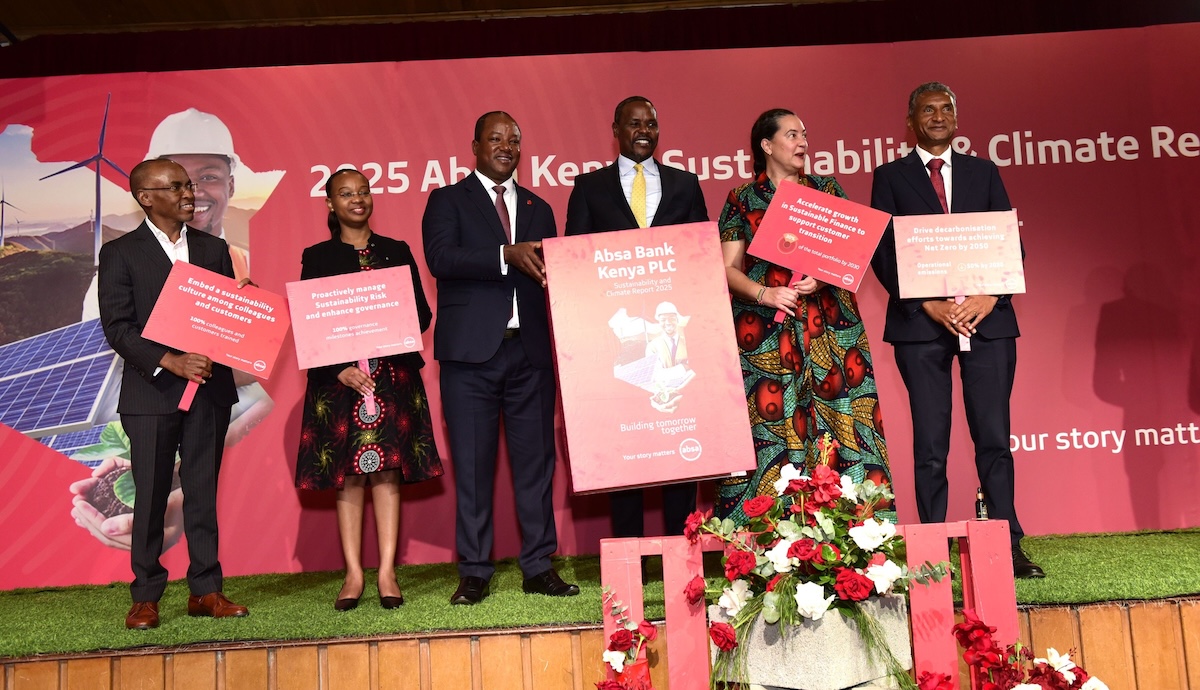
Absa Bank Kenya has channeled more than Ksh 204 billion into sustainable finance since 2022. The figure was disclosed on 28 July 2026 at Strathmore University, where the Bank unveiled its 2025 Sustainability and Climate Report.
In the year under review, the Bank disbursed Ksh 55.3 billion in sustainable finance, up from Ksh 47 billion in 2024. Of that amount, Ksh 48.8 billion went toward financial inclusion financing, supporting SMEs, women-led businesses, young entrepreneurs and underserved communities. A further Ksh 6.5 billion was directed toward climate finance, covering renewable energy, green buildings, energy efficiency and climate-smart agriculture.
The report shows that eligible sustainable finance made up 30 percent of the Bank’s gross loan disbursements in 2025, well above its original year-on-year target of 10 percent.
Speaking at the event, Absa Bank Kenya Interim Managing Director and Chief Executive Officer Yusuf Omari said the report reflects the results of the Bank’s 2021 to 2025 sustainability strategy, which was built around 13 commitments spanning economic, social and environmental impact. He pointed to work supporting business growth, affordable housing access, climate smart agriculture financing and broader financial inclusion as examples of where the Bank had directed capital. Omari said Absa remains committed to partnering with customers and stakeholders to build a more inclusive, resilient and sustainable future for Kenya.
Beyond financing, Absa also expanded its own environmental programmes in 2025. The Bank planted 283,969 trees during the year, nearly four times the 72,000 trees planted in 2024, bringing its cumulative total to more than 1.5 million trees. The Bank also reported a 96.4 percent waste recycling rate and a 41 percent reduction in its operational energy footprint, which it said reflects progress toward its net zero goals.
On social impact, nearly 38,000 young people were equipped with employability and entrepreneurial skills in 2025 through the Bank’s ReadytoWork programme, bringing total beneficiaries of that programme to more than 300,000 since its inception. The Absa Kenya Foundation also expanded work across its three focus areas, education and skills development, entrepreneurship, and natural resource management, reaching more than 50,000 individuals during the year.
Dr Festus Ng’eno, Principal Secretary at the State Department for Environment and Climate Change, attended the event and commended Absa for its role in advancing private sector climate action. He said climate change is already affecting livelihoods, infrastructure, ecosystems and economic productivity, and that the cost of inaction continues to rise, making climate investment both an environmental necessity and a sound economic decision. He called on financial institutions, investors and development partners to keep expanding support for climate solutions, green enterprises and sustainable infrastructure.
During the year, Absa said it strengthened its climate governance and risk management capabilities, embedding climate considerations into business strategy, lending decisions and enterprise risk management. The report also marks a shift in the Bank’s disclosure practices, with Absa aligning its reporting to the International Sustainability Standards Board framework, specifically IFRS S1 and IFRS S2.
With that strategy now complete, Absa used the event to launch its next one, built around four pillars. One keeps at least 30 percent of gross loan disbursements going to financial inclusion, green finance and nature based finance. Another targets net zero emissions by 2050. A third strengthens sustainability risk management and governance, and the fourth focuses on embedding sustainability into how the Bank operates day to day.
Never miss a story 💜
Breaking news, real stories and money tips for Kenyan women, as they happen.

