
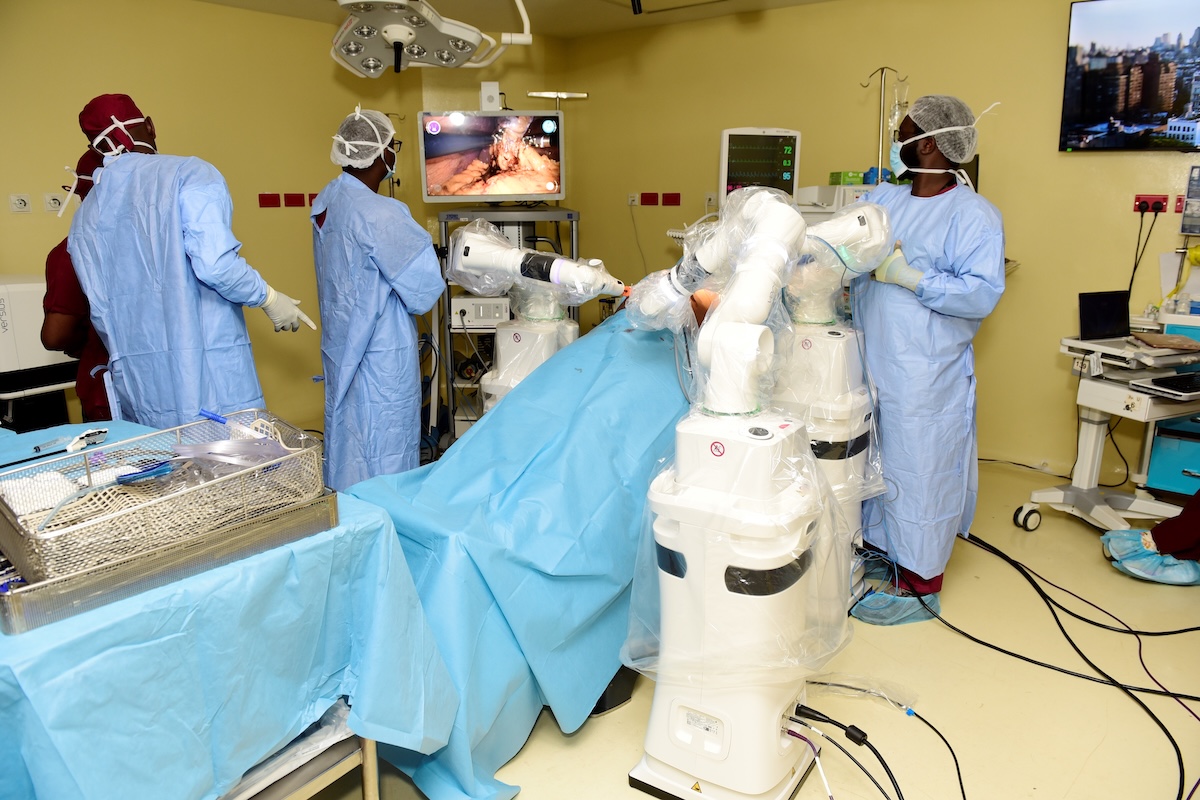
Surgeons at the Aga Khan University Hospital, Nairobi recently performed the region’s first robotic gallbladder removal surgery, a milestone that puts the hospital at the front of a shift in how surgery is being done across East Africa.
The procedure has a formal name, robotic-assisted laparoscopic cholecystectomy, but the idea behind it is fairly simple. It takes the skill of a well-trained surgical team and pairs it with robotic technology built to sharpen precision, improve visualization and give surgeons finer control during the operation. The result is a step forward in what’s known as minimally invasive care, and it puts AKUH,N firmly in the conversation as one of the region’s leaders in surgical innovation.
Dr Abdulkarim Abdalla, Chair of the Department of Surgery at the hospital, explained what sets this apart from conventional keyhole surgery. “Robotic-assisted surgery builds on the benefits of conventional keyhole surgery by providing surgeons with a three-dimensional view of the surgical field, greater flexibility of movement, and improved access to areas that can be difficult to visualize using traditional techniques,” he said.
It’s worth clearing up a common misconception here. Despite the name, the robot isn’t performing surgery on its own. There’s no autonomous machine making decisions in the operating theatre. The surgeon is there throughout, seated at a specialised console, controlling every single movement of the camera and instruments in real time.
What changes is the range of motion available to that surgeon. “The robotic instruments have a greater range of movement and closely mimic the motions of the human hand, enabling greater precision and control during surgery,” Dr Abdalla said. “This allows us to perform procedures more safely.”
There’s also a practical benefit that’s easy to overlook, fatigue. Long procedures take a physical toll on surgeons, and operating from a seated console rather than standing for hours helps reduce that strain. Combined with the enhanced vision and instrument flexibility the system offers, it gives surgeons more precision for the trickiest parts of an operation, tasks like stitching in tight, confined spaces where a small margin of error can matter a great deal.
For patients, the upside looks a lot like what’s already known about minimally invasive surgery more broadly, just refined further. Smaller incisions. Less pain after the procedure. Shorter hospital stays. Faster recovery than what patients typically experience with traditional open surgery.
CEO Rashid Khalani connected the achievement to a longer pattern at the hospital. “Since our inception, Aga Khan University Hospital has built a tradition of introducing many healthcare firsts for Kenya and the region,” he said. “This latest milestone continues that legacy. We invest in innovation because it enables safer, precise and evidence-based care for our patients.”
He was also clear that this isn’t meant to be a one-off achievement. According to Khalani, it marks the start of a longer effort to bring robotic-assisted surgery to more patients across the region, while also building out research and training in the field, work that could shape how surgical care develops well beyond this single procedure.
For a region where access to advanced surgical technology has often lagged behind other parts of the world, a milestone like this carries weight that goes past the operating theatre. It signals what’s becoming possible closer to home, and hints at a future where patients no longer need to travel abroad for the kind of precision this technology makes possible.
Never miss a story 💜
Breaking news, real stories and money tips for Kenyan women, as they happen.

