
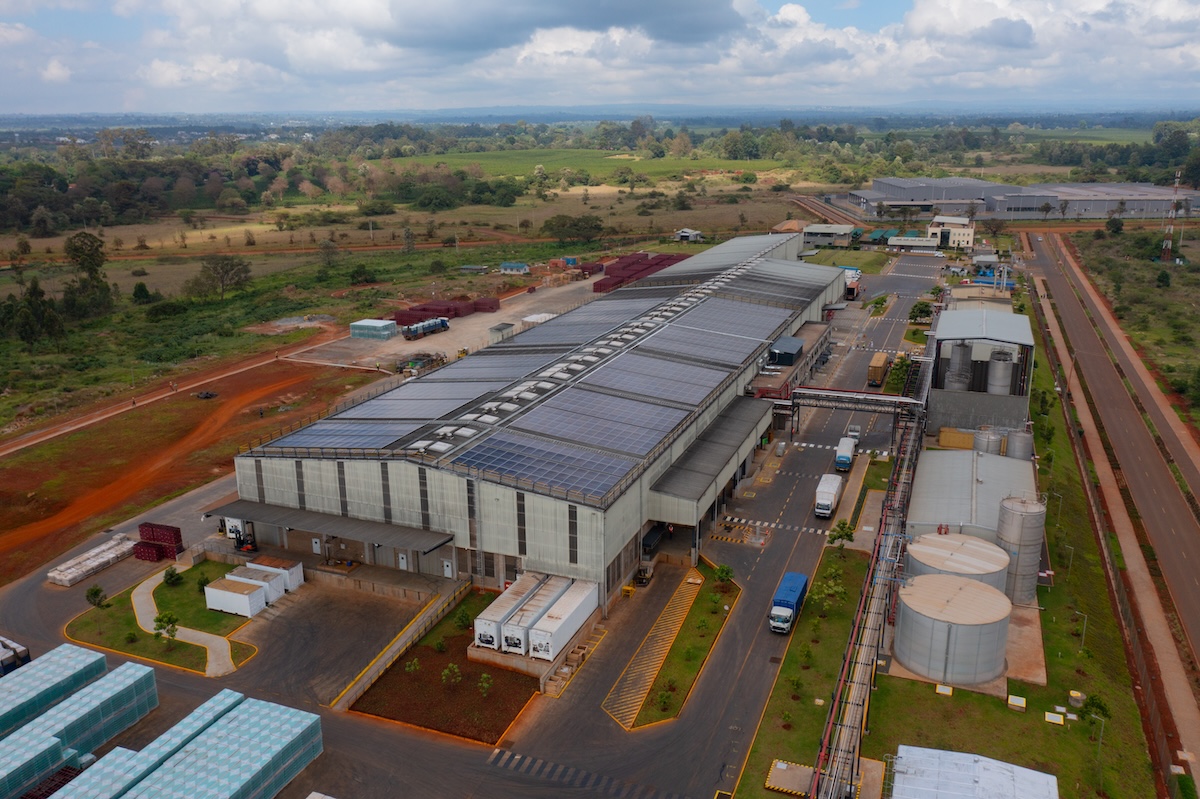
Inside KWAL’s Tatu City plant, the lights turn off on their own when nobody’s in the room, the rooftop is covered in solar panels, and water gets reused rather than dumped. Small details, but together they’ve been enough to earn the plant a EDGE green building certification, a global standard most Kenyan manufacturers haven’t come close to reaching.
EDGE, short for Excellence in Design for Greater Efficiencies, is a green building standard developed by the International Finance Corporation, a member of the World Bank Group. It’s recognized in over 170 countries and was built specifically to give companies a measurable way to prove that green buildings make financial sense, not just environmental ones.
The numbers behind KWAL’s certification tell the story. The Tatu City plant has cut energy use by 44%, reduced water consumption by 28%, and lowered embodied energy in materials by 53%. These aren’t small efficiency tweaks, they represent resources saved every single day of operation.
“KWAL’s achievement of EDGE Advanced certification is a remarkable demonstration that economic growth and environmental responsibility go hand in hand. Through practical, commercially viable solutions, KWAL has delivered a 44% reduction in energy use, a 28% reduction in water consumption, and a 53% reduction in embodied energy in materials, results that represent real resources conserved every single day,” said Gill Rogers, IFC Head of Country Office, Kenya.
At the center of this achievement is a 700-kilowatt rooftop solar power plant, commissioned in just eight months. The plant now covers 20% of KWAL’s annual power needs and has already cut the company’s annual energy costs by an estimated 10%. In a country where energy costs remain high and grid instability is a real operational risk, that kind of on-site power generation does more than save money, it builds resilience into the business itself.
“KWAL continues on its journey to lead the way in responsible manufacturing. We are deepening the synergies between our transformative growth and expansion ambitions to create a future-proof, sustainable business. This certification is a strong testament to our team’s commitment to our purpose to Craft a Better World,” said Lina Githuka, Managing Director, KWAL.
The path to certification involved several practical interventions working together. KWAL adopted a Power Purchase Agreement model to finance the solar installation, introduced a water recycling initiative, and installed motion sensor lighting across its offices, small changes that add up to meaningful, measurable impact when applied consistently across a large manufacturing site.
KWAL isn’t stopping at 700 kilowatts either. The company has confirmed plans to more than double its solar capacity to 1,500KW, a clear signal that this certification is a milestone rather than a finish line, and that energy independence remains a long-term priority rather than a one-off project.
The initiative fits within Heineken’s global Brew a Better World ambition, which guides subsidiaries like KWAL toward sustainability goals with the greatest potential impact. Under its healthy watersheds and nature commitments, Heineken has pledged to improve water efficiency and replenish water used in water-stressed regions, while also working to decarbonise operations through energy efficiency and a greater reliance on renewable power.
For Kenya’s manufacturing sector, KWAL’s certification offers a useful case study. It shows that cutting energy and water use at an industrial scale is achievable within a working timeline, and that the returns, both financial and environmental, start showing up almost immediately once the right systems are in place.
Never miss a story 💜
Breaking news, real stories and money tips for Kenyan women, as they happen.

