
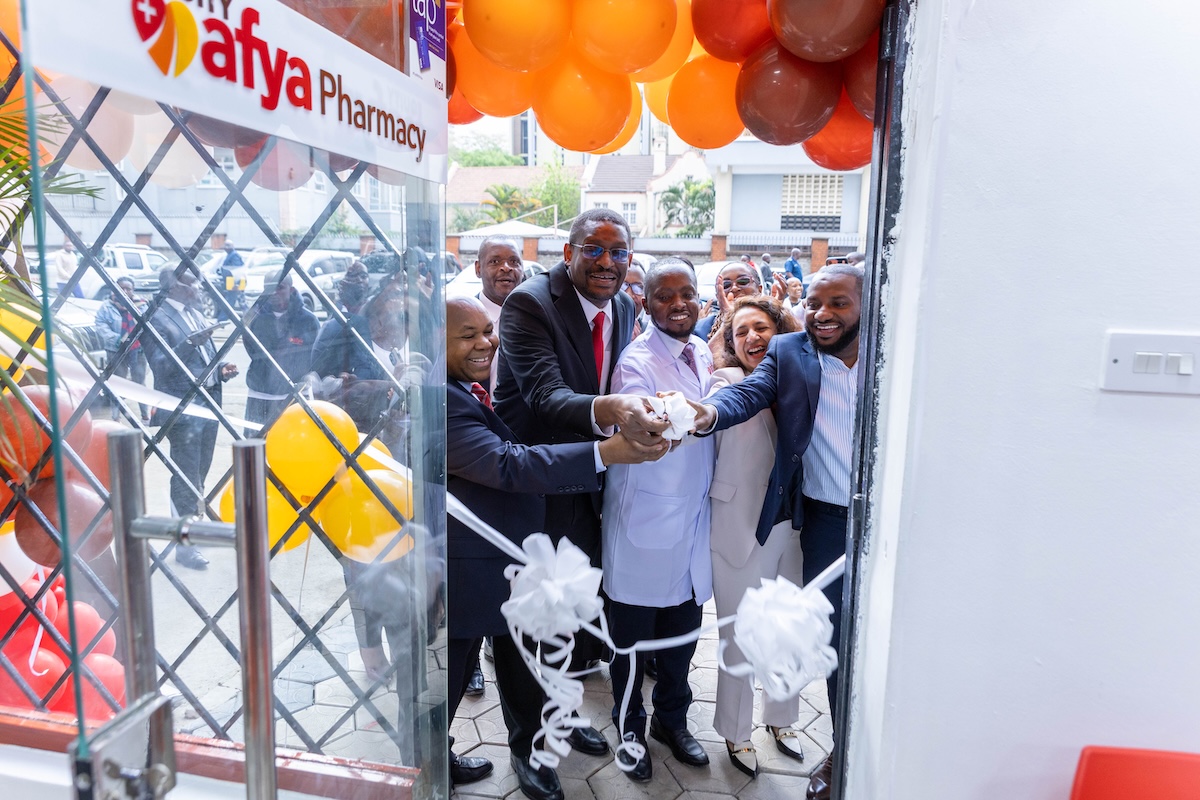
You leave the clinic with a prescription in hand and a feeling that the hard part is over. Then the second errand begins. Which pharmacy stocks it? Is it far? Is the price fair? For plenty of Kenyans, the gap between seeing a doctor and actually holding the medicine is where treatment quietly falls apart. Equity Afya has opened a pharmacy in Nairobi aimed squarely at that gap.
The new outlet sits at Bruce House, opposite Cardinal Otunga Plaza, and it is the organisation’s second standalone community pharmacy in the city. It is also the first to be owned and run by a franchisee, a sign that Equity Afya is moving towards a community-facing retail model alongside its network of medical centres. That network currently stands at 154 facilities across Kenya and the Democratic Republic of Congo, each with its own in-house pharmacy. The new model, developed in partnership with the Gates Foundation, takes medicines out of the clinic and puts them where people live and work.
Dr Dennis Ogolla, Managing Director of Equity Afya, says the idea rests on a belief that entrepreneurship can widen access to healthcare while producing businesses that last. The organisation’s job, he explains, is to build an environment in which health entrepreneurs can grow sustainable enterprises and extend essential services to more people. The CBD outlet was designed around proximity and convenience, and Equity Afya hopes to gather an ecosystem of certified professionals around it, including doctors, pharmacists and dentists. He sees the expansion as a complement to existing healthcare infrastructure, bringing services closer to communities.
Dr Gohil Jaimini, the Chief Pharmacist, describes the pharmacy as an extension of the success of Equity Afya’s clinics. The aim is to build on that foundation by offering affordable, quality medicines within communities.
Dr Benson Musyoka, a Health Systems Strengthening Specialist, put the problem in the plainest terms. Healthcare, he said, does not end when you see a doctor or collect a prescription. It ends when a patient has received quality, safe medicine. The pharmacy is meant to bridge the distance between a prescription and a completed course of treatment, providing what he called the last mile of accessible, quality and affordable medicines.
Shoppers at Bruce House will find over-the-counter and essential medicines, wellness products, baby products and other everyday health needs. It is the kind of range that makes a pharmacy useful for more than emergencies, whether you are after something for a cough or something for the baby.
The business logic matters as much as the shelves. Because the outlet is franchisee-owned, a healthcare professional gets a route into running their own enterprise without building everything alone. Equity Afya wants to grow a wider network of professionals and businesses around primary healthcare, and the pharmacy gives that network a dedicated channel for medicines and daily health products.
The ambition does not stop in Nairobi. Equity Afya is targeting 1,000 pharmacies across East and Central Africa, which would turn one franchise on a busy city street into the start of something much larger.
For now, the test is simple. A patient walks out of a consultation, crosses the road and finds what the doctor ordered, at a price they can manage. If that happens often enough, the last mile starts to look a lot shorter.
Never miss a story 💜
Breaking news, real stories and money tips for Kenyan women, as they happen.

